
Have you ever noticed how certain areas of the body tend to feel weaker or more fatigued than others? Many of our daily activities, like working at a computer, driving, slouching in a chair, or even just walking, rely heavily on repetitive forward movements. And over time, this can weaken your abdominals, overstretch your upper back, and compress your hips. The result is often a familiar combination: a sore or stiff lower back, one or both hips that feel pinched or stiff, and rounded shoulders or a stooped posture. But these five Pilates mat exercises can strengthen your abs, upper back, and hips to help!
To build strength in these areas, grab a mat and try these 5 Pilates exercises.
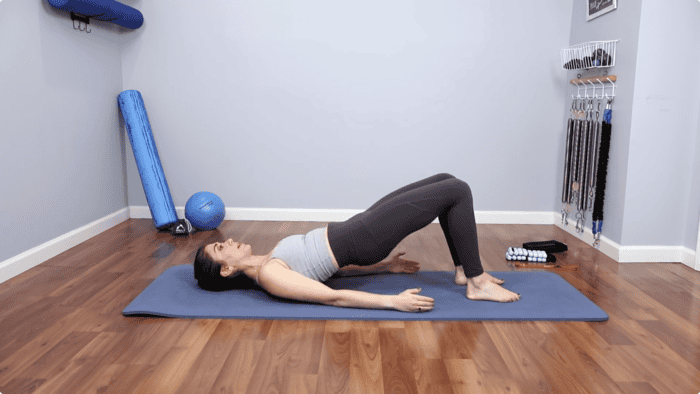
1. Pilates Bridge to Strengthen Hips
Pilates Bridge strengthens the muscles along the back of the body, particularly the abs, glutes, and hamstrings, while encouraging mobility through the spine.
Starting on your back with your feet planted on the mat, slowly lift your pelvis while keeping your ribs soft and your abdominals engaged. As the hips rise, they help support the movement while the spine gently articulates. Do 8-10, moving through each vertebra, like you’re picking up a string of pearls. Then do 8-10 without changing the shape of your spine, keeping your hips in neutral.
This exercise is excellent for reawakening the hips, opening the front, and strengthening the back, an area that can become underactive after long hours of sitting.
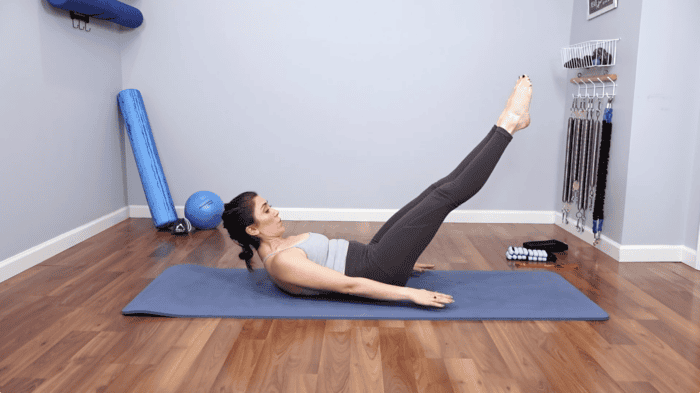
2. Pilates The Hundred to Strengthen Abs
The Hundred is one of the most well-known Pilates exercises and a powerful way to activate the deep abdominal system.
Legs can be tabletop, 90 degrees, or 45 degrees. Holding the leg position, reach through the arms, lifting the head, neck, and chest. The arms pump rhythmically. Inhale for 5 pumps, exhale for 5 pumps. Do this 10 times.
The abdominals work to stabilize the lower back; you should not feel pain or discomfort in your lower back. If you do, keep your legs at tabletop. The breath and arm movement create energy through the body and challenge your shoulder stability. This exercise builds core endurance while teaching the body to maintain support and control.
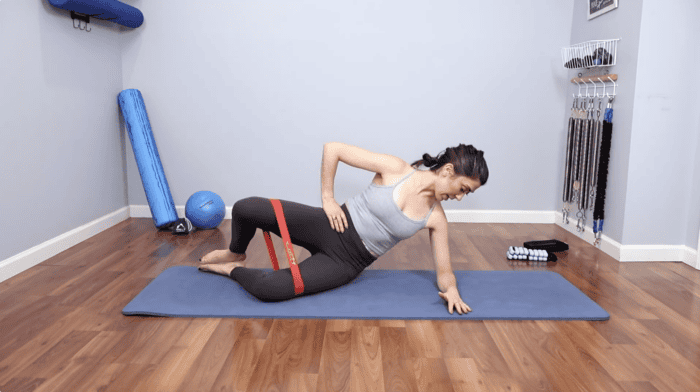
3. Pilates Clam Shells to Strengthen Hips
Clam Shells are small but incredibly effective for strengthening the lateral hips, especially the gluteus medius.
In a side-lying position, stack your hips so you are still in neutral. Option to prop yourself up on a forearm or lie completely on one side. Without rocking your pelvis, externally rotate your top leg, like a dog peeing on a firehydrant. It’s important that only your leg moves, not your pelvis or lower back. Pressing into the resistance band 10 times, keeping the heels together. Then lift the top leg, feet coming apart, top leg floating. Pressing into the resistance band 10 times.
The glutes play a crucial role in propelling us forward with strength and stability when we walk, run, or stand on one leg. Lateral hip strength is really important for balance. When your glutes aren’t properly firing, the hips can become unstable, and the knees or lower back often compensate, causing pain or injury. By focusing on slow, controlled movement, Clam Shells help isolate the hip muscles and improve lower-body alignment.
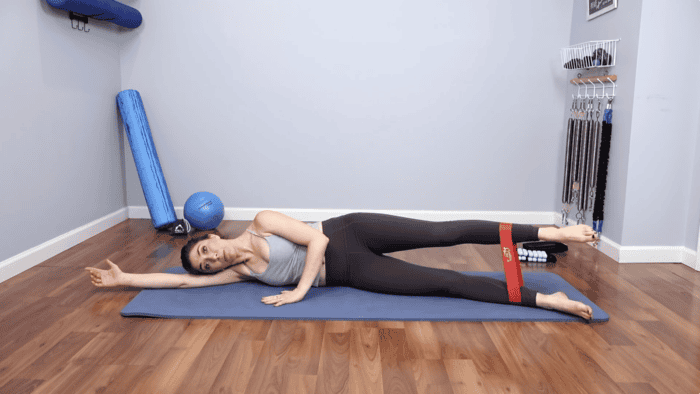
4. Pilates Side Leg Series to Strengthen Hips
The Side Leg Series continues to strengthen the glutes while adding more hip movement in abduction/adduction, hip extension/flexion, and circumduction.
Lying on your side, your legs are slightly extended in front of your body. Control the pelvis, holding it still as you move the top leg into the resistance band in different directions. 10 times up and down, 10 kicks front to back, and 10 small circles both ways.
This challenges both the glutes and the deep hip muscles to work together to maintain balance and control. Over time, this type of lateral strengthening can improve hip stability and support better overall movement mechanics between your femur bone, pelvis, and lumbar spine.
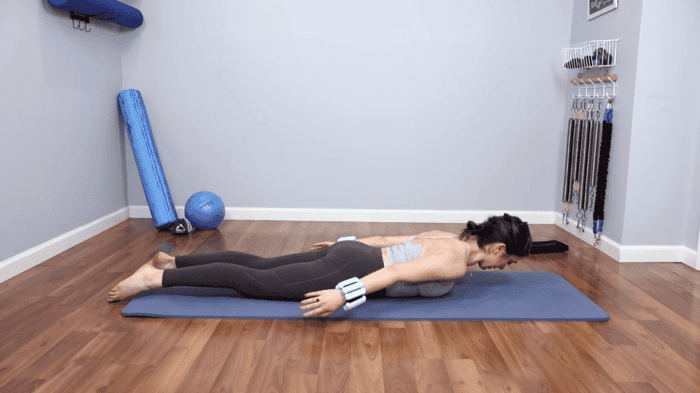
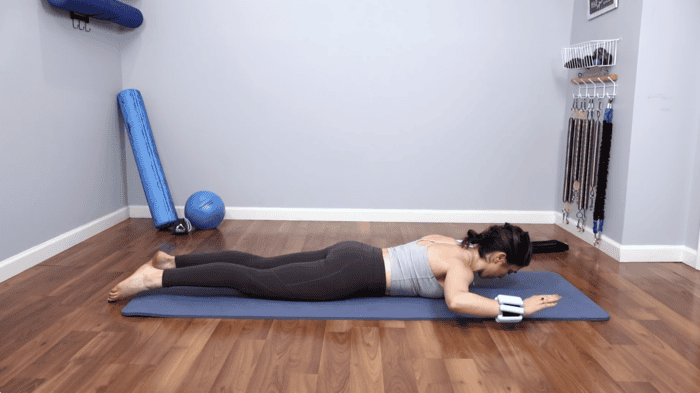
5. Pilates Prone Arms to Strengthen Upper Back
Prone arms like Rockets and Goal Post focus on strengthening the upper back and posterior shoulder muscles, which are essential for maintaining good posture.
Lying face down on the mat, retract your head so you don’t bonk your nose, and lif you chest just a little to find a small extension. Reaching the arms towards your hips, 10 times lift from the pinkie side of your arm, keeping the spine long and straight. Bending the arms to the goal posts: 10 times, lift the arms off the floor. Try keeping your hands higher than your elbows, without dropping your head, neck, or chest.
Lifting the arms while keeping the neck long and the spine in neutral encourages the muscles between the shoulder blades and the back of the shoulder to activate. These muscles help counteract the rounded shoulders that often develop from long hours spent sitting, working at a computer, and the forward hunch that can develop from cycling or running. Strengthening the upper back helps open the chest and support a more upright posture.
Strengthening the Back, Abs, and Hips Takes Time
As with any exercise routine, building strength and improving coordination takes time. The body adapts gradually as muscles become stronger and movement patterns become more balanced. Practicing these 5 Pilates exercises regularly can help strengthen your upper back to improve posture, engage the abs to support the low back, and improve glute activation to control hip and pelvic mobility. All of which contribute to better posture and more efficient movement. Consistency matters far more than intensity. Start slowly, focus on good form, and allow your body time to adapt.
Disclaimer:
THE INFORMATION EXPRESSED ON THIS SITE IS FOR EDUCATIONAL PURPOSES ONLY. WE DRAW ON OUR EXPERTISE AS PILATES AND MOVEMENT SPECIALISTS BY EXPANDING OUR PROFESSIONALISM THROUGH CONTINUING EDUCATION AND PERSONAL EXPERIENCES. WE AIM TO PROVIDE VALUABLE INFORMATION CONCERNING, BUT NOT LIMITED TO, PILATES, FUNCTIONAL MOVEMENT, AND FITNESS. YOU TAKE FULL RESPONSIBILITY FOR ALL DECISIONS NOW OR IN THE FUTURE CONCERNING YOUR HEALTH, LIFE, AND WELL-BEING. THIS INFORMATION IS NOT TO BE USED AS MEDICAL ADVICE, EITHER TO DIAGNOSE, TREAT, CURE, OR PREVENT ANY DISEASE OR AILMENT. YOU SHOULD CONSULT A PHYSICIAN BEFORE BEGINNING ANY EXERCISE PROGRAM.